
I Launched My Website…Now What? Everything You Need to Do After Going Live
Launching your website is a huge milestone, but it’s just the beginning. A great website sitting quietly on the internet with no follow up strategy won’t bring in clients on its own. Here’s a clear, honest look at all the pieces you need to put in place after launch to help your business actually get found, build trust, and grow.

You did it. The site is live. You’ve shared it with a few people, maybe posted about it on social media, and now you’re waiting for the enquiries to roll in.
And then… not much happens.
This is one of the most common moments of confusion I see with small business owners after a website launch. They’ve invested in a great site. One that looks professional, communicates clearly, and is built to convert. And then nothing seems to move. The site exists. It just isn’t being found.
A website is not a marketing strategy. It’s one essential piece of a much bigger puzzle. And until the other pieces are in place, your site is a little like a beautifully designed shop front on a street nobody walks down.
The good news is that the other pieces are within your control.
1. Set Up and Optimize Your Google Business Profile
If you do nothing else on this list, do this one. A Google Business Profile is one of the most powerful free tools available to a small business owner, and it’s one of the most consistently underused.
When someone searches for a service in their area, or searches for your business by name, your Google Business Profile is often the first thing they see. It shows your location, your hours, your website link, your reviews, and photos of your work. It tells Google that your business is real, active, and relevant.
A fully optimized Google Business Profile significantly increases your chances of appearing in local search results. For service-based businesses especially, this is often where new clients find you first.
2. Make Sure Your On-Site SEO Foundations Are in Place
If your website was built with strategy behind it, your SEO foundations should already be built into the structure, the copy, and the technical setup of your site. But SEO is one of those areas that is easy to underestimate and easier still to get wrong, and the consequences of getting it wrong are invisible until you start wondering why nobody is finding you.
SEO is a long game. It takes time for Google to index your site and start ranking your pages, which is why getting the foundations right matters so much.
This is one area where working with an expert from the start pays for itself many times over. Whether that’s a website strategist who builds SEO into the design process from day one, or an SEO specialist you bring in to audit and strengthen your existing site, this is not the piece of the puzzle to figure out through trial and error. The posts that follow in this blog will go deeper on what good SEO actually looks like and what it takes.
3. Connect Google Search Console and Google Analytics
These two free tools are non-negotiable for any business serious about growing online, and setting them up right after launch means you'll have data from the very beginning.
If your site is built on a platform like Squarespace, you already have access to built-in analytics, and it's a great starting point for understanding your traffic at a glance. But connecting Google's tools gives you a significantly deeper and more actionable picture, and they're free to use alongside whatever platform you're on.
Google Search Console
This tells you how your site is performing in Google search, what queries people are using to find you, which pages are being indexed, and any technical issues Google has flagged. Think of it as Google’s direct line of communication with your website.
Google Analytics
This tells you what’s happening once people arrive on your site: how many visitors you’re getting; where they’re coming from; which pages they’re spending time on; and where they’re dropping off. Without it, you’re essentially flying blind.
4. Get Listed in Online Directories
Beyond Google, there are a number of online directories and listing sites that can help your business get found and build what’s known as “citation authority”. Essentially, the more consistent mentions of your business name, address, and website that exist across the internet, the more trustworthy Google considers you to be.
Depending on your industry and location, relevant directories might include:
Apple Maps
LinkedIn company page
Industry-specific directories relevant to your niche
Your local chamber of commerce or business association website
The key is consistency, make sure your business name, address, phone number, and website URL are identical across every listing. Inconsistency confuses search engines and dilute your credibility.
5. Start Creating Content That Brings People to You
Your website is built. Now it needs some on-going energy. Content, in all its forms, is one of the best ways to drive consistent, long-term traffic to your site and establish yourself as the go-to expert in your field.
You’re already reading an example of this strategy. This blog exists to answer the questions my ideal clients are asking, demonstrate my expertise, and give search engines a growing body of relevant, useful content to index. Over time, every post becomes another door into my business.
But blogging isn’t the only form content takes. Some of the most effective approaches I’ve seen my clients use:
Podcasting
Several of my clients run highly popular podcasts in their industries, such as Anne Morriss and Frances Frei’s podcast, Fixable. A podcast builds trust with an audience in a way that written content often can’t. People spend sometimes an hour at a time with your voice in their ears. Each episode also becomes a piece of content that can be repurposed into blog posts, social media clips, and email newsletters, multiplying its value significantly.
Blogging
A well-structured blog with consistent, relevant content is one of the strongest long-term SEO strategies available to a small business. Each post targets a different search query, builds your topical authority, and gives potential clients a reason to keep coming back. The key word is consistent, sporadic posts have far less impact than a regular publishing schedule, even if that schedule is just once or twice a month.
Email Marketing
Email is one of the most underrated tools for a small business owner. Unlike social media, your email list is an audience you own, no algorithm decides who sees your content. Several of my clients use email newsletters to stay front of mind with their audience, share their latest content, and drive consistent traffic back to their website. If you’re not building an email list from day one, you’re leaving a significant long-term asset on the table.
Social Media
Social media won’t directly improve your search rankings, but it plays an important supporting role. It’s where you show up consistently for your audience, share your content, build relationships, and direct people back to your website. The platform matters less than the consistency. Pick the one or two channels where your ideal clients actually spend time and show up there regularly.
6. Start Collecting Reviews From Day One
Reviews do two things simultaneously: they build trust with potential clients and they signal credibility to search engines. A Google Business Profile with a strong collection of genuine, detailed reviews will outperform one with none almost every time.
The best time to ask for a review is immediately after a positive experience, when the value is fresh and the client is at their most enthusiastic. Make it easy by sending a direct link to your Google review page rather than asking them to find it themselves.
7. Show Up Where Your Clients Are
Digital strategy matters, but it works best alongside real-world visibility. Networking, both online and in person, remains one of the most effective ways for a small business to build momentum, especially in the early stages.
This might look like:
Participating in your local chamber of commerce
Attending or speaking at industry events and conferences
Engaging in online communities, groups, and forums where your ideal clients spend time
Building relationships with complementary businesses who serve the same audience and can refer clients to you
Being active and visible on LinkedIn, where business conversations happen
Your website is where people go to verify that you’re the right choice. Networking is often what puts you in front of them in the first place.
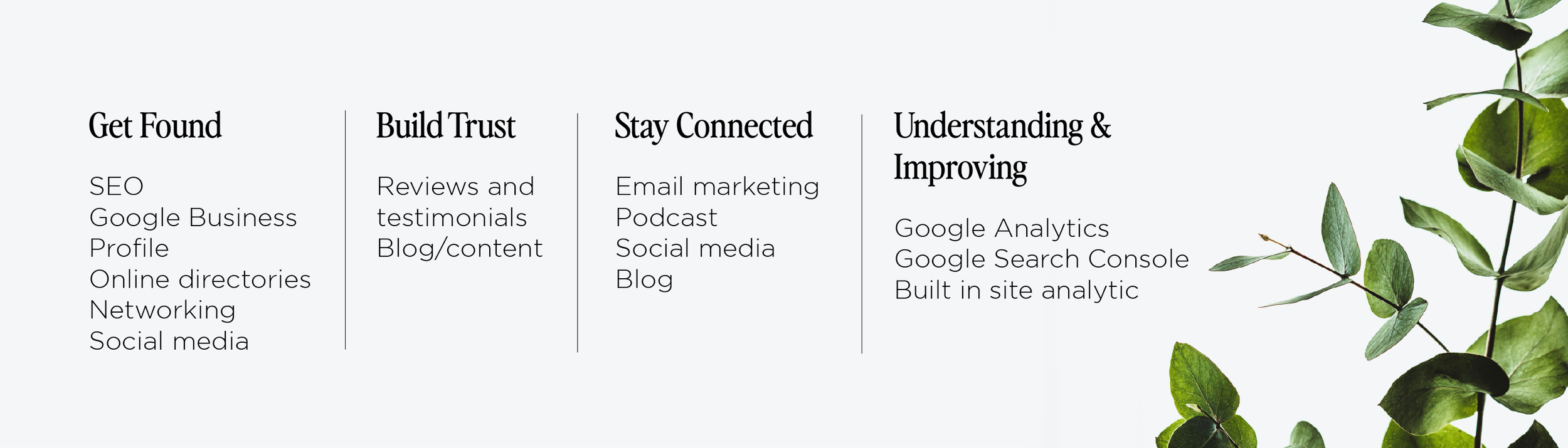
Think of It as an Ecosystem, Not a Checklist
Reading through this list, it might feel overwhelming. But keep in mind, you don’t need to do everything at once.
The most important thing is to start. Set up your Google Business Profile this week. Connect your analytics. Pick one content channel and commit to showing up there consistently. Ask your next happy client for a review.
Each piece you add strengthens the others. Your blog drives traffic to your site. Your site converts that traffic into enquiries. Your reviews build the trust that makes those enquiries convert into clients. Your Google Business Profile amplifies your visibility in local search. Your email list keeps your audience connected between visits.
A great website is the foundation. Everything else is what turns that foundation into a business that gets found, builds trust, and grows consistently over time.
The businesses I see grow most steadily online aren’t the ones who did everything perfectly from day one. They’re the ones who built the foundation and then added pieces consistently, over time.
Not Sure Where to Start?
If you’re feeling unsure about where your web presence currently stands, what’s working, what’s missing, and what to prioritize, a brand audit is a great place to begin. It gives you a clear, outside perspective on the full picture so you can move forward with confidence. Find out what a brand audit includes.

Bev Yeager is the founder of The Design Wonder Studio, a Boston-based design studio specializing in brand strategy and website design for coaches, consultants, speakers, and small businesses. She started her own business from scratch ten years ago and brings that firsthand experience to every client she works with. Learn more about Bev or book a free consultation.
