
How Much Does a Small Business Website Design Cost? A Honest Breakdown
If you’ve started researching website design costs, you’ve probably already noticed the answers are all over the place, anywhere from a few hundred dollars to tens of thousands. That range is real, and understanding what drives it is one of the most important things you can do before you invest. Here’s an honest breakdown of what small business website design actually costs, what you’re paying for at each level, and the red flags that tell you a quote is too good to be true.
You searched “how much does a website cost” and got approximately no useful answer. One article says $500. Another says $50,000. Someone on a Facebook group says their nephew built theirs for free.
The truth is that web design pricing varies enormously, and for good reason. A website for a solo bookkeeper is a very different project from a website for a multi-service consultancy. What you’re paying for isn’t just design; it’s strategy, expertise, time, and the long-term value a well-built site brings to your business.
So instead of giving you a number and calling it a day, I want to walk you through what actually drives the cost, and how to use that knowledge to make a confident, informed decision.
What Does a Small Business Website Actually Cost?
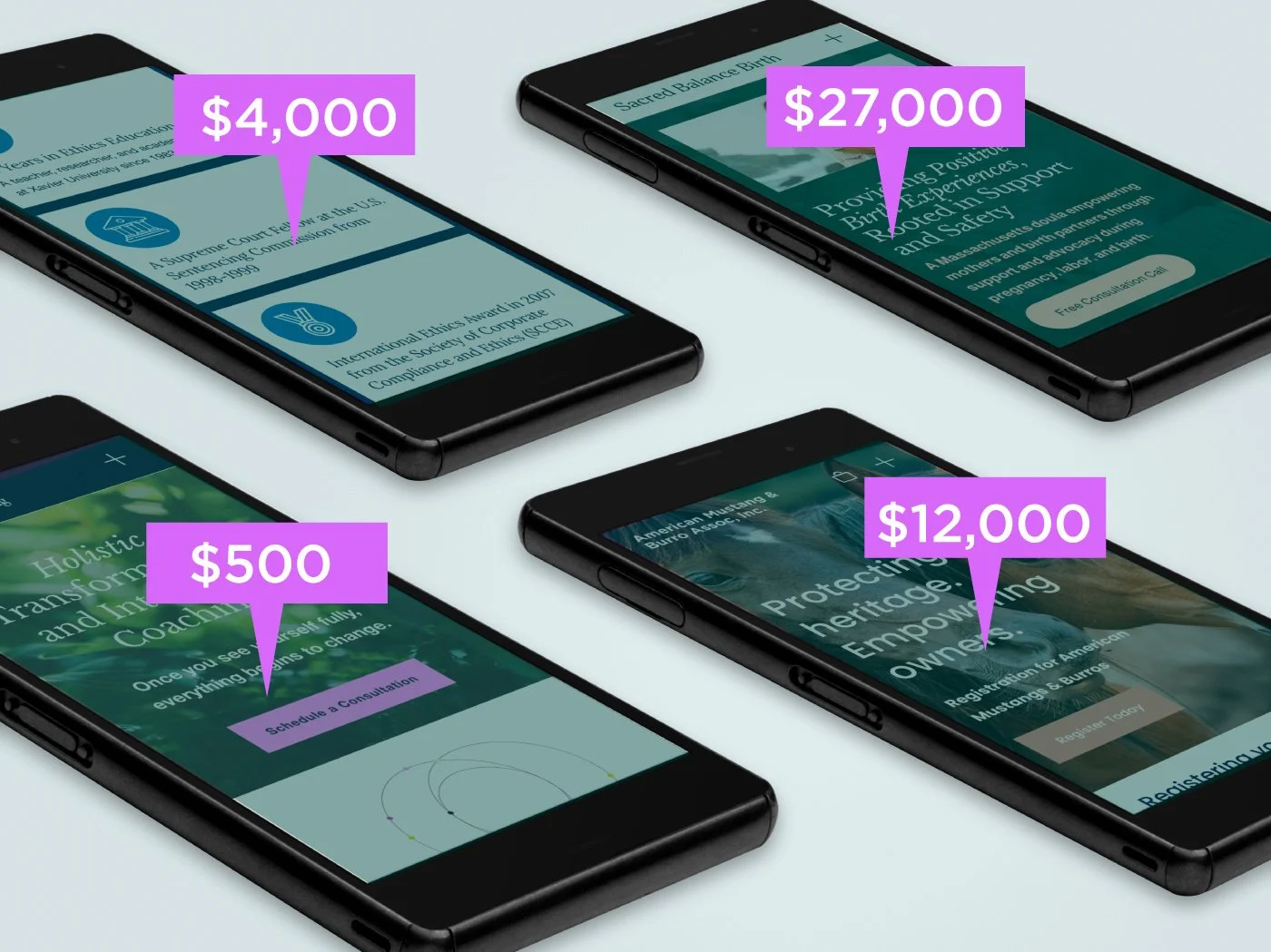
For a professionally designed small business website, you’re generally looking at a range of a few $1,000 on the lower end to $15,000 or more for a larger, more complex project. My own projects for small businesses typically fall between $5,000 and $15,000, depending on the scope, the number of pages, and the level of strategy and design work involved.
Here’s a rough breakdown of what different investment levels tend to look like:
Entry-Level Professional ($1,000–$3,000): At this range you’re typically getting a smaller site, three to five pages, from a newer designer or someone working from a template with limited customization. The design may be clean and functional, but the strategic depth is usually minimal. Good for a very simple business with a tight budget, but not a lot of room for nuance.
Mid-Range Professional ($3,000–$9,999): This is where you start to get proper strategic thinking behind the design. At this level, a good designer is considering your messaging, your ideal client, your positioning, and your conversion goals, not just making something that looks nice. You’re getting a site built to do a job, not just to exist.
Full-Service Professional ($10,000–$15,000+): For more complex businesses, multiple services, multiple audiences, larger page counts, or a full brand identity included alongside the website, this is the range where everything gets the attention it deserves. Strategy, brand, copy guidance, design, and a site built to grow with your business.
What Actually Drives the Cost of a Website?
Two designers can quote very different prices for what sounds like the same project. Here’s why, and what you’re paying for at each level:
1. Number of Pages
More pages means more design, more copy, more strategy, and more time. A five-page site and a ten-page site are very different projects. As I covered in my last post, the right number of pages for your business is a strategic decision, not just a preference.
2. Custom Design vs Templates
A designer working from a template and applying your colors and logo is doing something very different from one building a custom design around your brand, your audience, and your goals. Both exist in the market but the results are not equivalent.
3. Strategy and Discovery Work
The best designers, and the ones whose work actually moves the needle for your business, spend significant time on strategy before they touch a design tool. Understanding your ideal client, your positioning, your messaging, and your conversion goals takes real time and expertise. That work is baked into the price, and it’s one of the most valuable things you’re paying for.
4. Copywriting
Some designers include copy guidance or copywriting in their process. Others deliver a design and expect you to fill it in. If you’re writing your own copy, the total cost to your business is lower on paper but higher in time, and poorly written copy will undermine even the best design.
5. Functionality and Integrations
Booking systems, e-commerce, membership areas, custom forms, CRM integrations. Any functionality beyond a standard informational site adds complexity, time, and cost.
6. Brand Identity
If your project includes logo design, brand guidelines, and visual identity work alongside the website, as Jill Wetzler’s did, that’s a significantly larger scope and should be priced accordingly.
7. Designer Experience and Expertise
A designer with ten years of experience solving business problems through design brings something a newer designer simply can’t yet. That expertise costs more and it also tends to be worth more.
Why a Very Low Quote Should Give You Pause
If you receive a quote that feels surprisingly low (we’re talking a few hundred dollars, or even just over a thousand) it’s worth asking what’s actually included. In most cases, a very low price means one or more of the following:
The designer is very new and building their portfolio, which means limited experience with the strategic thinking that makes a website actually work for your business
You’re getting a template with minimal customization. The kind of result that looks like hundreds of other websites and does nothing to differentiate you
The work is being outsourced overseas at very low rates, with limited communication and quality control
Important elements (strategy, copy guidance, revisions, ongoing support) are simply not included
If a quote is low enough to make you wonder how it’s possible, trust that instinct. A poorly built website doesn’t just fail to help your business, it can actively work against it. And fixing a bad website often costs more than building a good one would have in the first place.
I’ve worked with several clients who came to me after a bad experience with a very cheap option. Here are two situations I’ve seen more than once:
The Disappearing Designer
A small business owner came to me after an experience that, unfortunately, I hear variations of more often than I should. They had hired a designer who promised a high-functioning client funnel, a fast turnaround, and results fast. All for only a few thousand dollars. It sounded like a great deal. So they paid the deposit, and then they waited. They waited to hear about next steps. They waited for designs to review. Every time they followed up, the answer was the same: working on it. Weeks passed. Then more weeks. The designs never came. Nothing was ever delivered. The deposit was gone, the time was gone, and they had nothing to show for either. By the time they came to me they weren’t just frustrated, they were wary of the entire process.
The Template Trap
A client reached out wanting a new logo, but as we talked it became clear that the logo was the least of their problems. They had recently paid someone to build their website. What was delivered was a basic Squarespace site with minimal content, no real messaging, nothing that spoke to their audience or gave a visitor any reason to stay, enquire, or trust. There was no footer with the correct links. And not even any legal pages in place (no privacy policy, no terms and conditions, none of the basic protections that every business website needs to have). The client didn’t know any of this was missing because they didn’t know what to look for. That’s not a criticism of them, it’s exactly why hiring the wrong person is so costly. You don’t always know what you didn’t get until someone points it out. Our conversation about a logo quickly became a much bigger conversation about building something that actually served their business and, just as importantly, protected it.
In both cases, the clients share the same root problem: the clients didn’t know what they didn’t know.
When you’re not familiar with what a well-built website involves, a low price can look like a smart decision rather than a warning sign. That’s not a failure of judgment, it’s a failure of information. As I talked about in my last post, knowing when the timing is right to invest in a professional site is half the battle but knowing how to choose the right person when you do is just as important. A DIY site is honest about what it is. A cheap professional site often isn’t.
How to Evaluate a Web Design Quote Like a Pro
When you receive a quote, whether it’s from me or anyone else, here’s what to look for:
Is there a discovery or strategy phase included? A designer who jumps straight to design without understanding your business, your clients, and your goals is skipping the most important part of the process.
What exactly is included in the scope? How many pages? How many rounds of revisions? Is copy included or just design? What about mobile optimization, SEO foundations, and launch support?
What does their portfolio tell you? Do their previous sites look custom and considered, or do they all look like variations of the same template? Do they work across different industries and business types?
What happens after launch? Is there any support, training, or handover included? Will you know how to update your own site, or will you be dependent on them for every change?
Do they ask good questions? A designer who is genuinely invested in your business asks a lot of questions before they quote. If someone gives you a price after a five-minute conversation, that tells you something.
Think of It as an Investment, Not an Expense
The best way to think about website design costs isn’t as a line item to minimize, it’s as an investment with a return. A well-built website works for your business every single day. It attracts the right clients, communicates your value clearly, builds trust before you’ve ever spoken to someone, and converts visitors into enquiries.
One new client won through your website, a client you might not have landed with a DIY site or a cheap template, can pay for a professional site many times over. The question isn’t really “how much does a website cost?” The better question is: “what is a website that actually works worth to my business?”
Not Sure What’s Right for Your Business?
If you’re trying to figure out what level of investment makes sense for where your business is right now, I’m happy to have that conversation. There’s no one-size-fits-all answer, it depends on your goals, your stage of business, and what you need your website to do for you.
And if you’re not quite there yet investment-wise, a brand audit is a great place to start. It gives you a clear picture of where your current web presence stands and exactly what to prioritize when you’re ready to move forward.

Bev Yeager is the founder of The Design Wonder Studio, a Boston-based design studio specializing in brand strategy and website design for coaches, consultants, speakers, and small businesses. She started her business from scratch ten years ago and brings that firsthand experience to every client she works with. Learn more about Bev or book a free consultation.
